Friday, June 27, 2014

Love in a hard place

I've just entered one of my photos in the National Geographic Traveler Photo Contest 2014 under the section "spontaneous moments"   Please click the website to vote for my photo - a rare moment of happiness in Zaatari refugee camp, Jordan  

Thanks! 

Monday, March 11, 2013

Join a candlelight vigil + support peace - #Syriacrisis


Working to Help Syrian Refugees in a Male-dominated Environment


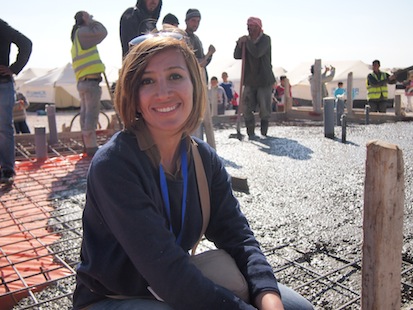
Amid a sea of male construction and site workers in Jordan's sprawling Zaatari desert camp, Oxfam's female engineer, Farah Al-Basha stands out from the crowd.
The energetic 27-year-old Jordanian joined the Oxfam team earlier this year, quitting her job at a private engineering company to work for the aid agency.
Instead of working on military and defense contracts and designing underground bunkers, she now helps to oversee work building toilet and shower blocks and installing water tanks at Zataari's refugee camp. She's been involved in drawing up quality, safety and inspection plans; liaising with and advising contractors; and carrying out on-site inspections to ensure standards are met at every stage along the construction project.
2013-03-08-P3060248.JPG

"I wanted to work with an NGO to help people here, to try to do something more for the community. For me, work shouldn't just be about the money," she said.
But she admits her first visit to the camp was a bit of a shock. "It was the first time I have ever been to a refugee camp and, honestly, it was overwhelming", she said. "I had only seen this on television, not first-hand. I realized this job was going to be totally different in terms of what it required of me than my previous work.
"It's been a life-changing experience for me. Helping to change people's lives is not an easy thing to do. It's also a difficult thing to realize that, as much as you want, you cant help everyone everywhere."
In Zaatari camp, Farah is a woman on a mission: determined to show that women engineers are just as capable as their male counterparts and making sure she is up to date on all the latest reading and research to make sure that no one can fault her. Farah's day-to-day work involves overseeing and inspecting the work of the (all-male) laborers and making sure everything goes to plan -- or if it doesn't, finding solutions to daily problems.
2013-03-08-P3060296.JPG

"Every day is crazy and every day is really busy," says Farah.
When I visit, she points out wide cracks in the cement floor of a new block which will house toilets and showers. "Look, the cracks are so wide," she says, pointing to the floor where she has marked in red ink the words "rejected."
"This will cause problems... the contractors will have to fix it," she says, shaking her head.
She's firm but polite as she speaks to the contractors, pointing out the problem. But they accept what she says. "I'm very demanding and quite strict, but they respect me," she says. "They realize I am not here for a fashion show, but I'm an expert and know what I'm talking about.
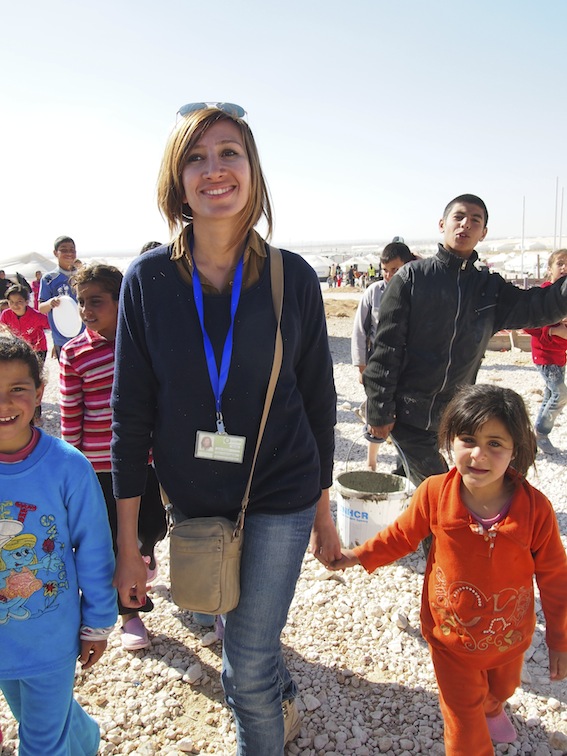
"Every day, big groups of women and children follow me as I work in the camp," she says. "The girls say they see me as a kind of role model and say they'd like to do work like me when they are older."
2013-03-08-P3060268.JPG

"The children in the camp love to see us work: they make sure they are awake and up and about when we arrive in the camp for our day's work."
Farah had hoped to recruit an all-female team to work with her, but the first female junior engineer she hired quit after a few days into the job. "It's a shame. This woman was very shy and it was really difficult for her to deal with the male laborers. You have to be firm," she says. "There are many women engineers in Jordan, but most chose not work on-site but stay working in offices. I've been working as an engineer for the last six years and I'm always the only female engineer on site."
Undaunted by some of the setbacks, Farah is full of plans and ideas. She's hoping to pass on some basic engineering and plumbing skills to some people in the camp; and to get women in the camp more involved with the work Oxfam is doing.
Spending most of her days in the camp, she says, is a tiring but rewarding experience.
"We're surrounded by children for most of the day. We walk together, we eat together, we share stories and dreams. When the time comes to leave the camp, we get into our car, tired and exhausted with messy hair and dirty jeans, with our faces a bit more darkened by the sun than the day before.
"We're thinking about how lovely a bubbly shower will be, but before closing the doors, the kids come and say 'See you tomorrow' and we close the doors with a big smile, forget about how dirty we are, or how lovely this bubbly shower will be and we start thinking about what can we do next for those kids."

Follow Caroline Gluck on Twitter: www.twitter.com/carooxfam

Tuesday, February 19, 2013

Syria's worsening humanitarian crisis

Syria's humanitarian crisis is dramatically deteriorating. The UN estimates 2.5 million people displaced by conflict inside the country need help, while there are now more than 800,000 refugees who've fled to neighbouring countries, including Jordan - with record numbers arriving in January. Oxfam is among the many agencies responding to urgent needs inside Zaatari camp, which houses more than 90,000 refugees.

Monday, January 21, 2013

A refuge from Syria conflict still brings misery for thousands in Lebanon

Take a look at the hands of married women who’ve fled Syria to take refuge in neighbouring Lebanon and you’ll notice that almost all aren’t wearing any jewellery. Many families fled the fighting in Syria with little more than the clothes on their backs. Desperate, traumatised, and in severe need, families were forced to sell off whatever they had with them to get out of the country, find a flat or a space to shelter and buy food for the family – even if it meant selling off a precious wedding ring and other gold jewellery. Fatena, who used to live in Yarmouk camp for Palestinian refugees, in Syria, starts to cry as she tells me her family’s story. Most inhabitants of the camp, near Damascus, fled when violent clashes between pro-regime fighters and rebel militants, escalated dangerously. Fatena says her family paid $400 dollars to pay for a car to the Lebanese border. They arrived on Christmas Eve. “The drivers exploited our miserable situation and asked for much more money than normal”, she said bitterly. The same is true for rents. With a large influx of more than 200,000 registered and unregistered refugees arriving in Lebanon, normal rental prices for even the most basic of buildings in many areas has increased two to three-fold as landlords have been taking advantage of the demand-driven market. Fatena had to sell off her jewellery, including her wedding ring, to pay for the basics. She points to one pretty ring on her finger. “This is worthless. It’s not gold, just a bauble”, she said. “No use to anyone” Safely inside Lebanon, families worry about the future. Most have managed to pay some rent now, but have no money for rental fees in the coming months. Their homes, which are often just garage spaces, are mostly damp, unheated and unfurnished. It’s not uncommon for large family groups of up to 20 people to live in just two to three rooms. They worry about how they’ll pay for food and heat, with most unable to find work; fret about their children’s health, with many getting colds and bronchial infections, and whether their children will ever have a chance to go to school again. The cost of living in Lebanon is way higher than in Syria. Life each day is a struggle, though many neighbours and family members have lent the newcomers what little they have including blankets, cooking utensils and some rugs. Oxfam and its partners have also been distributing blankets and mattresses to some of the neediest families during what has been the worst winter weather conditions in 20 years. Hanaa’s family are among those who benefitted from our help. Despite her difficulties, she laughs and jokes as she explains the set-up of where she’s living. Three families, a total of 15 people, share a couple of dark rooms and more relatives are on their way. Its an old building, draughty and unheated. Seeping rainwater has caused large patches of damp and peeling paint on the walls. And in the bathroom, she laughs, pulling a face, there are rats. “Lack of money is the biggest problem we face. We have no washing machine, no fridge, no gas, no winter supplies, no food, no way to find any work”, she says. Another relative living with her, Alaa, an English teacher, nurses her four month-old son. She and her husband have both been unsuccessfully looking for work. She says her two young children have become sick and developed bad coughs. Everyone huddles close to each other at night to stay warm. “It’s so expensive here”, she laments. “But I have hope things will be better, that we can go back home and the violence will end. We used to live like kings [in Syria] but here we are like beggars. We beg for people’s help. This is killing us: we feel so ashamed.” Out in the courtyard, her relatives’ children play. They’ve got wooden sticks, which they wield like rifles, and aim as if they are taking shots at each other in a war game. All are less than ten years old. Way too young to have witnessed the atrocities of war. But clearly, already scarred by what they have seen. ends

Thursday, December 20, 2012

Typhoon hit families in the Philippines struggle to recover

More than a thousand people have been killed in the destruction left by Typhoon Bopha in Mindanao, the southern island of the Philippines. Thousands are still living in evacuation centres - their homes totally destroyed. They face an uncertain future since the typhoon wrecked huge plantations of crops and it could take farmers many years to completely recover. Aid agency, Oxfam, is providing clean water, shelter materials, and cash grants for families in some of the worst-affected areas. One area includes these families living in New Bataan, Compostela Valley.

Saturday, December 15, 2012

Typhoon Bopha - death toll increases

Typhoon Bopha wreaked havoc in the Philippines, leaving tens of thousands of people without homes, fields and crops devastated, and 955 dead, with more than 800 still missing. Oxfam and other agencies are responding to people's emergency needs providing clean water for drinking washing and bathing, shelter materials, hygiene and water kits. We've also given cash grants to families still living in evacuation centres.. See some of our work here.

Tuesday, October 16, 2012

Picture Story

Picture Story: Picture Story

It's #World Food Day: see how #Oxfam's #ECHO-funded projects in #Yemen are helping some of the poorest families to eat ow.ly/evn4k

Sunday, September 30, 2012

Yemen's Hunger Crisis - C4 news coverage


#Yemen's hunger crisis - desperate families, desperate measures Channel 4 News ow.ly/e5ZIl

Thursday, September 27, 2012

Yemen: coping with a hunger crisis.


≥ Yemen is in the midst of catastrophic hunger crisis with 10 million people -- almost half the population -- without enough food to eat and five million people needing urgent assistance. In the northern districts of Haradh and Abss in Hajjah governorate, one of the poorest areas of Yemen, families are fighting for survival and resorting to desperate measures to cope and feed their families.

Friday, August 10, 2012

Ramadan in Yemen - the hardest year ever

As Yemen is gripped by its worst-ever humanitarian crisis, with 10 million going hungry and more than five million in urgent need of assistance, this year's Ramadan is proving harder than ever. In better years, Yemenis would traditionally stock up with food as the Muslim fasting month Ramadan approached. Special purchases of sweet items like dates and juice would be among the items. Breaking the fast with iftar dinners at night with family and friends would be a celebratory event.
Copious amounts of food are still available in the markets: fresh fruit and vegetables, breads, all kinds of grains, sweets and dates. In small shops, the bright colours of boxes and tins red, gold and green are dazzling. The problem is that the cost of food items has rocketed and Yemen, which imports around 90% of its food needs, is particularly vulnerable to global food prices. "How can someone with a big family and no work afford to buy anything with these high prices?" complained one woman I met in the city market of Al Hodeidah. The high price of diesel -- which has doubled in Al Hodeidah in the past month -- has also had an impact. A date farmer in the wholesale market told me he spent three times as much money on fuel to operate pumps to irrigate his palm trees; but his crop size was about 20% less than normal. In the debilitating heat, which hits the high 40s centigrade, ice is in high demand. But according to one shopkeeper, the cost of powering generators to keep the ice cold in freezers has seen prices rise seven-fold. This year, many families are struggling to pay for the most basic of items. Large numbers skip meals and survive on little more than bread and tea. And that's why international aid agency Oxfam has provided a cash lifeline to more than 100,000 people in Al Hodeidah, giving them a cash lifeline so they can get through the next few months, and feed their families. Widower, Zuhra Wans, in her 50s, who lives in Bayt al-Faqih district, in Al Hodeidah, can only dream of better years. "Things were good three years ago," she recalled dreamily. "Then, during Ramadan, everything was available." She reels off a list of what she used to buy -- items that are now far beyond their reach. Today, family meals mostly consist of bread. In her small house, in Al Hawak village, Zuhra takes me into her kitchen. There's just one eight kilo sack of grain that the family will use to make bread. She tells me it used to cost 800 riyals (nearly $4 US dollars); today, its costs 1,400 riyals (about $6.5 US dollars). The sack will only last them for two weeks, and she's already worried by how much her next purchase will cost.
Zuhra shows me the only food they have in the kitchen At least one-third of all households in Yemen are surviving by buying food on credit. Shopkeepers, in turn, buy their stock on credit. The local markets mostly operate on this precarious system. So far, its worked. But shopkeepers like 25-year-old Ala'a Abdullah Farag Wans, who has a small store in Al Hawak, sleep poorly these days, worried that their customers won't be able to pay them back - and the defaults could prove devastating. "The majority of my customers buy on credit" he said. "On average, my customers owe me about 30,000 riyals ($139 US dollars) each month.
Ala'a worries he may be forced to go out of business because so many owe him money I worry one day I'll go out of business because my customers can't pay me back. Sometimes, I get calls from traders asking me when I'm going to pay them their money. Others stop by the store to ask me the same question. Another shopkeeper, 23-year-old Yunus Al-Hamadi, tells me a similar story. "We're owed about 4 million riyals in debts by our customers. We buy our food from wholesalers and owe them about nine million riyals." But Yunus is philosophical about the future. We don't worry, he says, because we can't change anything. We just live day to day. Follow Caroline Gluck on Twitter: www.twitter.com/carooxfam

Monday, July 23, 2012

Yemen's hunger crisis worsening

Tens of thousands of people will be left without aid in Yemen’s hunger crisis unless more money is urgently given to the aid effort, Oxfam and Islamic Relief have warned. Nearly a quarter of the population are in need of emergency aid to survive because they do not have enough food to eat. The aid agencies said they needed an additional $38 million to carry out their work and have been forced to delay aid programmes due to start this month because of lack of funding. Oxfam’s programme for Hajjah in northern Yemen, which was due to give 140,000 people cash to buy food, was put on hold two weeks ago. Another aid programme to help over 300,000 people this July in the badly hit rural area of Al Hodeidah on Yemen’s west coast has been scaled back to help just 100,000. Islamic Relief needs $2million to help an additional 180,000 people with nutrition and early recovery assistance – none of this money has been raised to date. Oxfam is aiming to help one million people, but only has funding to reach a quarter of that figure Colette Fearon, Oxfam’s Country Director in Yemen, said: “Yemen is dealing with a catastrophic food crisis and people really need our help. People are getting into worrying levels of debt just to get food for their families – and surviving on a meagre diet of tea and bread. One woman told Oxfam how she planned to sleep in the day to avoid the hunger pangs. We have the capacity to respond - plans have been prepared and staff are ready. But lack of funding is severely limiting what we can do. If we got the money we needed today, we would be able to scale up straight away and begin reaching the people who desperately need our help.” The warning came as the UN increased the amount of money being sought for its Yemen appeal in response to mounting needs. The appeal increased from $447 million to $591 million. It is just 42 percent funded. Some 10 million people – 44 percent of the population of Yemen – do not have enough food to eat. The UN estimates that 267,000 Yemeni children are facing life threatening levels of malnutrition. Yemen is now in the midst of its hunger season, before the next harvest in October. The start of Ramadan is also pushing up prices in markets. For example, sugar and wheat prices have increased by 21 percent and 42 percent in rural areas compared to prices last month. The aid agencies called on more donors to fund the aid response, warning that failing to help people quickly could cost lives now and have serious consequences for Yemen for decades to come. Hashem Awnallah, Islamic Relief’s Country Director in Yemen, said: “One in three children under five in Al Hodeidah is acutely malnourished – double the level that constitutes an emergency in UN terms. Children are being taken out of school to work, and an increase in early marriage has been reported. As well as being dangerous for children’s health, this crisis could rob children of a decent future and lead them to poverty, alienation and unrest.” The agencies said although $4bn was pledged at the Friends of Yemen meeting in May, where world leaders met to discuss the country’s future, it is unclear when this money will arrive in Yemen and how this money will be spent. The agencies said donors needed to respond to humanitarian needs immediately and stressed that they should look beyond food aid. There is food available in markets in Yemen, but people cannot afford to buy it. The agencies said that donors can help poor Yemeni families by ensuring that they have the cash they need to purchase food. Check out my photostory on BBC Online:- http://www.bbc.co.uk/news/world-africa-18834478

Tuesday, May 22, 2012

Behind prison walls in Congo (DRC)

I’ve often had to document Oxfam’s hygiene promotion activities in communities, schools, markets and other public places. But never a prison. Until now. In Bunia town, Ituri district, in Congo’s Orientale Province, Oxfam’s health and emergency response teams have been tackling a serious cholera outbreak. We’ve been working with a local water provider, Ngongo, to try improve water supply to sections of the town. In Bunia, however, only half of all neighbourhoods receive any treated water and the amount per person is only about a quarter of what humanitarian agencies normally say are acceptable levels. According to a UN report last year, an estimated 51 million people, or three quarters of the population in Congo, have no access to safe drinking water. During the current cholera outbreak in Ituri district, more than 2,000 cases have been reported and 56 cholera deaths have been confirmed. Oxfam has set up two large water treatment units; treating water from the city’s Ngezi river with aluminium sulphate and then chlorinating it so that it’s safe to use. The water treatment means we can provide an extra 180 cubic metres of water a day, helping more than 40,000 people receive clean water. Recently, reports surfaced of a possible cholera outbreak in Bunia’s Central Prison prompting Oxfam to begin work there too. We began providing water and installing hand washing facilities at the request of the ICRC (the International Committee of the Red Cross) which had been working in the prison, while other arrangements were made for the water to be trucked twice a day from our water treatment centre. Oxfam staff are also carrying out hygiene promotion activities at the prison.
It was an eye-opening visit. The prison is severely over-crowded. Built for 200 inmates, it currently houses over a thousand; mostly men, although there are also separate compounds for minors and women. Before our intervention, the prison received just 1,000 litres of piped water a day, barely a litre per person for drinking, cooking and washing. There are no beds and only a few dark, unlit and unfurnished bare-floor rooms that are crammed with people. Most inmates normally have to sleep outside in the prison courtyard because of lack of space. But heavy rain the night before my visit forced prisoners to get shelter where they could – some even slept in the toilets to stay dry. It’s easy to see how disease could spread like wildfire here. People tightly packed together with poor sanitation facilities, including maggots in the toilets, while the number of toilets is woefully insufficient for the large number of people, and there was not enough water for drinking, washing or cooking. The scarcity of water meant most prisoners were only able to wash once a week.
I watched as public health promotion team leader, Emilie Bhania, spoke to a large group of male prisoners who’d gathered for our visit. She spoke about good hygiene and the importance of hand washing. The prisoners listened attentively and asked questions. Many raised problems that they were still facing due to overcrowding and sanitation Later, several told me disease was rampant. There had been cases of typhoid; and many inmates had serious respiratory illnesses and skin diseases. I was told matter-of-factly that several prisoners had died and that cholera was not the cause. Inmates said they were very happy that Oxfam was now helping and that it had made their difficult conditions a bit better.
Cholera has become endemic in eastern Congo. Last year, an estimated 22,000 cases and 600 deaths were reported. Oxfam’s work in areas like Bunia has made a difference. But its clear that huge problems remain. People might understand and know what they need to do to prevent cholera, but unless they have access to the basics, things like clean water and soap, its still going to be very difficult to keep cholera at bay in the future.

Saturday, March 24, 2012

Trying to build security where fear prevails - in eastern Congo

Eastern Congo is supposed to be at peace. But life for civilians in Mweso health zone, Masisi territory, North Kivu, is anything but peaceful.

Although a peace agreement was signed three years ago, ongoing instability, violence, a worsening humanitarian situation and festering ethnic tensions continue to make life precarious for civilians.

The lush, green fertile valleys, punctuated by farmed land that resembles neat patchwork quilts, are stunningly beautiful. But life here, where Oxfam operates public health and protection programmes, funded by Irish Aid and a multi-donor UN fund, is no rural idyll.

In Mweso, where Oxfam has a field base, local staff briefed me on the complexities of the area. Political rivalries, geo-politics and migrants from neighbouring Rwanda, many of whom have long-established family links in Congo, military abuses, a proliferation of militia groups, land grabbing, informal "taxes" demanded by militia on the roads and pervasive violence added up to a lethal cocktail and meant that daily life for people here was a constant struggle.

Another three-hour journey, through yet more breathtakingly beautiful scenery along roads edged with young children waving and shouting out as our cars pass, takes us to Mpati, where Oxfam is carrying out training workshops.

The tension in the air is palpable. I’m warned to be extremely careful before taking any photographs or video. Mpati, a camp housing thousands of displaced people, as well as returnees and a settled community, is one of the most sensitive locations in which we work. Soldiers, nursing their AK47s, keep a watchful eye over everything.

Not so far from here, in hills across the valley, is a frontline, where military clashes continue.

Oxfam staff are holding training sessions with local community volunteers and women's groups. They include members of local volunteer protection committees, set up with the help of Oxfam. Their role is to try to help spread awareness in the community about people’s basic rights; support victims of violence to get access to services and lobby the local authorities for action to respond to abuses. No easy task in a place where people live in fear.


The sessions I attend address issues of sexual and gender based violence, HIV and aids, which are almost-daily challenges facing communities here. There’s also discussion about land conflict and unofficial checkpoints, where many are forced to pay a “fee”, forced labour and arbitrary arrest. Participants think about what they might be able to do about these issues - but when they look at the risks, only the smallest and safest actions are possible.


One morning I visit a site where Oxfam has installed a safe water source point, making it easier for people to collect clean drinking water. All water points have been carefully planned, with the input of local protection committees, I learnt, so that there were multiple exit points for people, mostly women, collecting water if they came under attack.

In town, I met Kanyere- not her real name - a member of the local protection committee. The fresh-faced teenager said she had joined because she’d wanted to help make life safer for her family and her community.

She told me that, since Oxfam began working in the camp, there had been positive changes. Since awareness training had been carried out in the community, she said, people’s behaviour had begun to slowly change.

But such is the atmosphere of control and repression here that I later learnt Kanyere had been questioned by officials about her conversation with a foreigner.

Clearly, there's a long way to go before people feel that security is more than just a word here. Our protection work is helping, but it’s not a quick or easy fix.

Yet, as Fred Delva, Oxfam’s protection manager in Mweso told me, through training different groups in the community, providing spaces where people can exchange views, we were hoping to plant a seed that, hopefully, will continue to grow and bear fruit to nourish the community.

Sunday, January 15, 2012

Haiti - two years on


Also see another version of my slideshow in The Guardian: http://www.guardian.co.uk/global-development/video/2012/jan/12/haiti-two-years-on-audio-slideshow

I wasn’t looking forward to returning to Haiti. Two years ago, I was one of the first of Oxfam’s emergency team to fly to the island, arriving three days after it was hit by a devastating earthquake, which killed more than 220,000 people and left over a million homeless.

It was one of the toughest emergencies I’d ever had to cover. It was really only after I’d left Haiti, almost three weeks later, that I’d realised the powerful emotional impact it had left on me. Even today, with time and distance, I can barely read a story about Haiti in the news without becoming teary-eyed.

So it was with some apprehension that I found myself on a plane headed for Port au Prince, the traumatised capital of the poorest country in the Western Hemisphere. I’d been hearing about the recent cholera outbreaks; the slowness of the recovery effort; and the fact that more half a million people were still living in the camps, many still in tents and under tarpaulin. I was scared that what I’d see now would be little better than the Haiti I’d left behind two years earlier.

First impressions weren’t good. Rubble still lay in the streets – though much of it was carefully piled up, many collapsed buildings still remained balancing precariously and fighting for survival in between other spaces where rebuilding had taken place.

And then there were the tented camps. Not the flimsy shelters made out of clothing scraps and plastic sheets I’d become so familiar with on my first visit. These camps appeared depressingly permanent. It seemed people were settling down for good; that what had been a temporary option was now the only long-term solution available.


The National Palace still lies in ruins

Sadly, for many tens of thousands of families that is not the case. They’re camped on private land, not public spaces, and now face the threat of forced evictions, often through the use of violence, from the owners who haven’t received any rent for the past two years.

I spent the first few days retracing my steps. The old Oxfam office – part of which had been seriously damaged in the quake – had been remodelled and repainted and was now the office of a private company; the damaged annexe had been fenced off and the collapsed top two stories had been removed.

The enormous camp for displaced families occupying what had been a golf course in the leafy and well-to=do suburb of Petionville was still bursting at the seams. Although the number of residents had decreased, people were still living check-by-jowl. The daily struggles for the basics: clean water, some privacy, and work, were still as pressing as ever.

I returned to the neighbourhood of Baillergeau, in Carrefour Feuilles. It had been one of the worst-hit areas I’d visited two years ago with around 90% of houses flattened, debris piling and obscuring the road and thousands camped out on what had been a football field. The campsite was no longer there. Most people had moved into transitional shelters, rather than proper homes and a lot of the rubble had been cleared.

There was a lot of rebuilding going on; noisy trucks tore up and down the narrow, dusty and windy roads with various building materials. There were many people along the roadside selling food and other basic necessities from small kiosks. Some had received small grants from Oxfam to restart their businesses.

It was in Baillergeau that I found Marguerite Ulysse. She’d given birth to a baby girl two days after the quake. Now, two years on, she was pregnant again. Her baby, Neika, was a healthy, gregarious and mischievous toddler.

We hugged in greeting and then sat down to talk. While daily life had been a struggle, Marguerite was neither pessimistic nor bitter, but grateful for the help that she and others had received from Oxfam and other aid agencies.


Marguerite Ulysse and her daughters

True, she admitted, she had been hoping that change would happen more quickly. But these were the realities. She was happy for the small things: that her husband, who’d been trained as a policeman, would have work; that her children were healthy; that her oldest daughter was still in school.

Her main concern was shelter; she wanted to move away from the rubble and the dirt and into a permanent home they could call their own.

“’The most important thing for me is the future for my children. When I die, I want to know I can leave my daughters a place where they can grow up”, she told me.

I visited more sites over the next few weeks where Oxfam and its partners have been working: installing water and toilet facilities in communities and schools, carrying out health promotion activities to try to control the spread of disease like cholera; supporting people to start up in business again with grants and skills training, including literacy classes which have given people a new-found sense of pride and purpose.

I want to say Haiti has changed a lot over the past two years. But I can’t. The emergency aid effort and the donations that flooded into Haiti after the quake undeniably helped save lives and provided basic and essential services, including food and water, to millions. But rapid progress in Haiti’s reconstruction and rebuilding has been quite another issue.


Yet the thing that struck me when I first visited and continues to strike me today is the energy, creativity and the intelligent spirit of its people – despite the daily difficulties and the challenges. Haitians are survivors; realistic, but not defeatist. They still hope for change and believe that some day, change will come.

Thursday, December 8, 2011

An economic lifeline for women in rural Haiti

“Unemployment is the only thing we have here”, declared Dumel Deralus, smiling grimly as we sat in the shell of a concrete building that will soon be a new expanded home for the Organisation for Community Development in Thomazeau, (ODECT), an Oxfam partner working to improve economic and social conditions in the town, about two hours drive north-east of the Haitian capital Port au Prince.

Dumel Deralus

Thomazeau is a rural area in western Haiti, home to about 52,000 inhabitants and picturesquely surrounded by mountains, little-touched by the earthquake two years ago. In fact, it was an area that saw a large influx of arrivals from the capital, Port au Prince, immediately after the quake. But it is also economically deprived. Most people here are “planteurs” – small-scale farmers living off their land and selling what crops they can. But poor roads are a major problem in getting goods to markets. And, as Dumel told me, there are few economic opportunities available in the community.

That’s also true across Haiti, where an estimated 75 percent of the population are not in salaried employment, and jobs are scarce. Unemployment is especially hard in rural areas, where there are few economic opportunities available, even the most casual of jobs. This was a major issue in Haiti, as much before the earthquake as now. But, after the quake, it’s also hampering people’s ability to rebuild their lives. According to an Oxfam survey last year, finding work is the top priority for most Haitians.

And that’s why a project which Oxfam supports in Thomazeau is raising the hopes of many women.

The women have their own section within ODECT known as RAFARE, or “Rassemblement des Femmes pour l’Accès aux Ressources Économiques” : Rallying Women to Access Economic Resources, to try to improve their economic status. The group owned one milling machine and earnt money processing grain brought into the centre by farmers and merchants. Oxfam hired them after the earthquake to help provide milled cereals which formed part of food kits that were distributed in the outdoor camps where people had sought shelter after the earthquake.


Marie-Claude Estenfile

Oxfam is now helping the women again - with funds and training, including enlisting the help of expat Haitian experts with specific skills - as they move to a new phase. The group are modernising their service centre and expanding their operation. The small building where they’re currently located will double in size, allowing them to have storage facilities where they can stock processed and unprocessed grains; buy and market milled cereal grains. Oxfam has helped them to purchase two new grinding machines and is providing training and other equipment.

The goal is to enable the women to run their operation as a proper business. They will buy and sell locally produced grain throughout the year, rather than just seasonally; and during lean times, in between the harvest periods, the surplus stocks can be released and sold in the local market.

“It will bring more economic opportunities here; there will be more jobs and more money coming in”, said Marie-Claude Estenfile, general secretary of RAFARE “There was always a shortage of grains being sold in the local markets from April to June; but we will be able to provide processed grains during that period.

“It means people won’t have to travel an hour or more to some of the markets, like in Croix de Bouquets, 24 kms away, to buy what they need. It will be easier to purchase food locally and we will help to strengthen the supply chain. The markets will be busier; the money will benefit the local economy”.

Having proper storage facilities and being able market their own cereals will enable the women to work all-year round, and not just stay open for business during the busy harvest period.

For Dumel Deralus, co-ordinator of the project and of ODECT, the project will create new jobs and improve people’s access to food. “It will guarantee people’s food security here. During the lean periods, people would have to buy imported rice and grain from other places. But we will have stocks to sell and supply to the local markets.”

RAFARE’s members are excited about the project, which has only just got underway. “It gives me hope for the future”, said 40 year old Hermircie Alfred. “I hope we can buy and sell the grains locally all year round; and we can make more profits.”

“There are very few job opportunities here”, said mother of eight, Alexina Augustin, 45. “The only jobs we can really find are selling cereals and this project will help us.


Alexina Augustin

“I lost my home and land a few months ago during flooding and now I can’t send my children to school. This will be a lifeline for me” she said.

Sunday, September 18, 2011

Between a rock and a hard place

Every few minutes, a gust of wind blows, forcing people to screw up their faces in pain against the fierce sand-dust that tears into their eyes, and forces its way into their mouths, ears and noses. Only the large scarves traditionally worn by women for modesty offer any protection against the dust which covers everything in a thick layer of yellowish brown in a few seconds.

Around a thousand Somali refugees arrive each day at this camp, Hiloweyn, in Dollo Ado, Ethiopia, just a few kilometres from the border with Somalia. They’re been moved here from a transit site about an hour’s drive away. Many have walked for days by foot. They’re weak and nearly everyone is malnourished.

Their new home is a dusty, rocky and windy spot. It might seem the last place on earth that anyone would want to stay. But for these refugees, who have fled extreme drought, famine and conflict, for now at least, its much better than what they left back home in Somalia.

Fifty year-old widow, Habiba Abdullahi, left her home in Dinsor, Baidoa region, walking for eight days with her son, a farmer, and his family. She told me that they used to own nearly 20 cows but that they had all died in the drought. There had been almost no rain over the past three years, she said, and it was impossible to grow crops. Their decision to leave Somalia, she said, was a decision to leave for good – as there was “nothing left for us to go back for”.


Habiba Abdullahi

“We had no rains and no food. We feared for our lives because of the drought. We were living in unstable conditions. We decided we had to leave after the farmland dried up, and our few animals died. There was nothing for us. Life and our survival was becoming fragile and things looked fatal”.

Daily life here is difficult. Families are given a tent which is hot in the day and cold at night; there is no vegetation providing any precious shade, apart from some small shrubby, thorny bushes.

Oxfam is helping to provide clean drinking water for the refugees. But as the camp swells in size and has been created from nothing, water is still rationed and not available 24 hours a day.

“I cannot predict how long we will stay here. But I think it will be for the rest of my life”, Habiba told me. “Whatever conditions are like, even though things are very harsh here, we have no option. Its still better for us to live here than back home.”

“There were no schools back there where we lived. There was persistent drought and nothing to eat. The crops had all dried up. Our animals had died. We need to begin a new life here and I think it will be a better life for my grandchildren.”

30 year old Nishe Hussein, a mother of four, left her home in Lug. She used to sell tea at a hotel. But the night it was bombed, and two people were killed she decided that there was no future for her in Somalia.

“We came here looking for food. If the food rations we get now improves, I will never go back to Somalia, because there is lawlessness and no government. I hope that now we are here, my children can go to school and get an education.”


Nishe Hussein

Mother of two, Sarura Mohammad Ibrahim, 24, from Dinsor, Baidoa,came to Ethiopia while she was heavily pregnant, travelling by donkey cart. She has now sold the donkey and cart and runs this small shop. She says she has no intention of returning to Somalia and that Ethiopia offers a better future for her and her family.

“Security is better here; also we have food and shelter provided by humanitarian organisations. Back in Somalia, we don’t have those things.”

Sarura Mohammad Ibrahim

Oxfam is providing clean water, building latrines and giving hygiene training for ten thousand people who are currently in the camp. It’s a race against time to install water tanks and tap stands so people can access water as the camp swells in size


Gathering water at Oxfam tapstand

There is a serious risk of disease spreading in the camps. And providing clean water, soap and toilets is essential to prevent that from happening.

“Oxfam is responding to this emergency crisis now by providing clean water and sanitation for people which will save lives but it also really improves the dignity of people”, said Oxfam’s Chief executive, Barbara Stocking.

“The work that we are doing isn’t going to be over very quickly, though, it will take months of work and we really would appreciate more funds coming in. It’s not also just the saving lives now that is the issue, but we need to work in the long term so people develop their own resilience and can cope with the sort of disasters that face them such as when drought comes so there’s a real need to keep this work going in the whole region to make sure that we don’t have these sort of crisis in the future; so there will be a need for funds in the long term as well. “

Oxfam has been working in the camp for the last few weeks. Its one of four in Dollo Ado, which is now sheltering more than 100,000 Somali refugees.

The aid agency, which in July launched its largest-appeal for Africa, is aiming to help 3.5 million people across Somalia, southern Ethiopia and northern Kenya – areas that are all affected by the severe drought

While aid is reaching affected communities, the worry is that the situation is worsening. Predictions of lower-than normal rains in the coming months could mean that this emergency continues well into 2012. People are going to need our help for months to come.