Thursday, August 9, 2007

looking for recognition


Representatives from one indigenous group in Taiwan held a small protest, near the Presidential Office in the capital, Taipei, calling on the government to grant them official recognition and status.


The event – held by members of the Pingpu lowland indigenous people’s – was held to coincide with the International Day of the World’s Indigenous people. The protestors handed in a petition with their calls to the Presidential office

The Pingpu people – numbering around 200,000 - live in Taiwan’s western lowland plains , unlike most aboriginal groups who come from the island’s mountainous areas and east coast. Their geographical location brought them into the closest contact with the first wave of ethnic Han Chinese settlers to Taiwan four hundred years ago, hastening their assimilation into the main population.

As a result, many of their customs and languages began to die out. Today, pingpu dialects are only spoken in three out of ten tribes – and mainly by the elderly. Activists say their traditional cultures and languages are in danger of dying out altogether – unless they get government help.

Over the years, the authorities in Taiwan have granted official recognition to 13 aboriginal tribes –who make up about 2 per cent of the population – which gives them access to greater government funding and support to promote their indigenous culture and languages.

The Pingpu, though, have not been successful in their efforts for recognition - having failed to meet certain thresholds on language useage, cultural observance or possession of territory. They argue the thresholds have been set too high. And they’ve levelled accusations of discrimination and exclusion.

Whether they’ll be able to succeed in future efforts to lobby for government support remains to be seen; but time is running out. And some scholars have warned that, without official help, the unique culture of the pingpu people could disappear altogether within the next decade.

Wednesday, August 8, 2007

Rainbows

We've had terrible rains over the past few days thanks to a tropical storm. But today was quite lovely..breaking in was the sun ..and a rainbow.


Wednesday, August 1, 2007

Austronesian links

Taiwan, its 6 Pacific diplomatic allies, and the Philippines, announced they were establishing an Austronesian Forum - aimed at promoting closer ties between Austronesian members.

What's "Austronesian" ? you may ask. The Austronesian language is the world's biggest linguistic group, spoken by more than 200 million people.

Many scientists believe Taiwan was the birthplace of the Austronesian language family. Another, more controversial theory suggests that Taiwan could have been the original homeland of the Austronesian people, who then migrated to a wide area across the Pacific and beyond.
A beautiful traditional boat build by Orchid Islanders who rowed for the first time from their island to Taiwan.


The new Austronesian Forum aims to promote exchanges, academic, economic and cultural, between Austronesian communities. The body will be formally established next year. A draft charter pledges founder members to work to promote the goals of democracy, good governance, human rights and sustainable development .


This Hualien chieftan gave a traditional blessing at a ceremony to launch the first step in setting up the Austronesian Forum.

In recent years, the Taiwanese government has worked hard to promote its links with other Austronesian countries - seeing it as a way of trying to break out of its diplomatic isolation and stress its distinctiveness from China.

The island is recognised by just 24 governments around the world - six of them in the Pacific . Taiwan's own Austronesian people are members of the island's 13 officially recognized aboriginal groups who make up about 2% of the population.

President Chen Shui-Bian pointedly reminded his audience that Taiwan's indigenous peoples - like other Austronesian groups - had their own ancient cultures and languages which were totally different and unrelated to the culture of the Han Chinese - the main ethnic group in China and Taiwan.

But, like many aboriginals around the world, Taiwan's indigenous peoples have also been marginalized and faced discrimination. In recent years, though, they have gained more political power and recognition. Establishing closer links with other Austronesian countries could give Taiwan's own aboriginal communities a greater sense of pride and leadership - and wider respect .

Saturday, July 28, 2007

Saving the green turtle

Green sea turtles are an endangered species around the world. But their populations are especially precarious in Taiwan.


A green turtle swims in a tank at the Turtle Conservation Centre, on Wang-an island, in Penghu.

Female turtles used to nest on many beaches around the island; but industrialisation, the loss of beach areas to development; as well as the killing of turtles for their meat and shells; and poaching of their eggs caused a rapid decimation of turtle populations.

There are now just two main nesting areas: in the Penghu archipelago (where several beaches are now protected reserves) and on Orchid Island. Both have documented around 12 female nesting turtles .a tiny population if you compare the same number, say in Hawaii..where populations are as high as 600.


The turtles are now a protected species in Taiwan. And efforts are underway to conserve the remaining numbers.

Their shells are brown or black in colour; but their bodies have a greenish hue becuase their main food sources are seaweed and microalgae.


Some turtles end up by accident trapped in fishing nets. Injured turtles are treated at a vetinary clinic at the Conservation Centre in Wang-an.


Prof. Cheng I-Jiunn, who has spent 16 years researching the green sea turtles, shows us one that's being treated at the Turtle Conservation Centre. It was found floating by the coastguard - and treated for malnutrition and minor injuries.

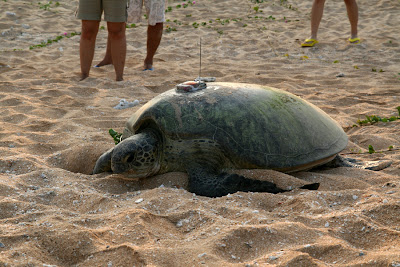
We were lucky enough to see one turtle nest on a beach. The green sea turtle is timid and only comes onto beaches to give birth at night. We were called out to one spot, where a turtle - bigger than 1 metre in length - had just laid her eggs. She was now digging a pit to carefully cover them - ferociously kicking up sand with her hind legs to cover them. It was pretty amazing to see the reptile frantically burying her eggs. And to reflect that turtles have been around 150 million years or so.

When she was finished, conservationists kept her in a wooden box on the beach overnight. They found she'd laid 138 eggs - a big batch (the average is 100-110) - which were taken back to the conservation centre, where they'll be looked after before they hatch.

Only about 70% of the eggs successfully hatch. And only 1/1000 babies actually make it to adulthood (20-50 years old) - when they will be mature enough themselves to give mate and give birth.

In one season, a turtle can nest 3-4 times; but that's it for another 3-5 years.....so its understandable why the populations are so precarious.

Early in the morning, Professor Chneg I-Jiunn, from the Institute of Marine Biology at the National Taiwan Ocean University, and student volunteers, attach a gps satellite transmitter on the turtle's back. It is state of the art equipment (costing around $7,000 US) and researchers hope it will give them vital clues about the turtle's lifecycle - especially its diving habits.

Fixing a gps satellite transmitter

After the transmitter is carefully glued, the turtle is released from its box...and inch by inch, clumsily works her way down the beach to the sea's edge.


Released from its wooden box

Ready to head home Crawling down the beach ... slowly does it...

Heading home, finally....


Turtles usually nest on remote beaches..and try to return to the same beach for future nestings, no matter how long it takes to travel there. But it abandons the sites if they're disturbed or have disappeared.

Whether we will see this one return, still remains to be seen....


Wednesday, July 4, 2007

new tourism attraction


Taipei has a new tourist attraction - what the city goverment are calling "gondolas" - cable cars that will take you across the southern Maokong mountain to the summit, which is home to dozens of tea shops and tea plantations.
The system stretches just over 4kms, and takes you from Taipei Zoo subway to the summit - hundreds of metres above ground level, with some quite spectacular views of the mountain and the whole city landscape.
Its cost the government nearly $40 m ($1.3bn nt) - but they believe its well spent : giving people a new tourist destination, and helping to bring tourists to the southern part of the city which has been relatively undeveloped.
The trip is supposed to take about 20 minutes..though technical glitches during our press run meant it took us about 50 minutes to return after several stops..swaying in the air! Another problem is that the cable cars - originally built and designed for ski resorts in Europe - dont have air conditioning. They are looking at other ways to increase ventilation in the cars, which can get very stuffy in Taiwan's oppressive summer heat.
But the verdict from fellow passengers: great fun, good scenery, and an enjoyable ride. A bargain too - just 50 nt to the top!

Friday, June 29, 2007

miscarriage of justice?

One of Taiwan's longest-running and most controversial criminal cases has once
again hit the headlines - sparking a big debate about the judicial system.
Su Chien-ho , Liu Bing-lang and Chuang Lin-hsun (pictured on their way to today's High court hearing) were teenagers when they were arrested sixteen years ago. They were given double death-sentences after the court found them guilty of robbery, rape, breaking and entering, and the gruesome murder of a couple in Hsichih, Taipei County, in 1991.
Various hearings later, the death penalties were upheld. But the three told lawyers their confessions had been extracted from them after they'd undergone torture by the police - including electric shocks to their genitalia.
In a retrial, in 2003, the High Court acquitted the men. But, just a few months later, the Supreme Court ordered a fresh trial - ending in today's verdict, which shocked defence laywers and supporters who had gathered outside the courthouse. There were highly emotional scenes - with most supporters, including some lawyers, in tears. One lawyer said it was an "international joke". The defence team symbolically turned their legal robes inside out - signifying their disgust at the verdict - and held a silent vigil on the steps of the court house. They have vowed to appeal again to the Supreme Court.
Amnesty International has been among the various human rights groups voicing concerns over the case. Last October, they wrote: "The case against the three is based almost entirely on their confessions which were allegedly extracted through torture at the hands of the police. These allegations combined with an apparent lack of material evidence and irregularities in the investigative process give us serious cause for concern that this case is a miscarriage of justice. "
Lawyers here say the case is "special" in many ways: and has helped bring about some real changes in the judicial system - for example, new rules that mean a case cannot be built only around confessions - but needs to have material evidence for convictions; allowing cross examination of witnesses by prosecutors and reducing the dominance of judges in a trial. But, they say, it also exposes the fact that, despite substantial reform, some flaws still remain .

Thursday, June 28, 2007

photography museum

Photographers gathered in Taipei's only art photography gallery, TIVAC, at the weekend to launch a campaign to try to raise funds and government support to establish a national photography museum - which could be the first in the Chinese speaking world.
While several museums (like the TFAM) have photography collections, many important historical photos are not kept in any special collection, but held by family members of photographers who have since passed away.
But a museum would be costly (several million USD) and there's also a problem of finding qualified staff to run it and help conserve fragile prints. No-one is under any illusion it will happen any time soon - but a dream has been planted.
"Photography is very important…. image is in fact related to our culture, society, and human being", said photographer Leon Tsai, one of the organisers of the campaign.
Lee Yong-Pin, head of Taipei's cultural affairs bureau, is supportive of the idea; but also says funding is a problem. She says some other cities have combined fine arts museums with a photography museum - and that might be a possible alternative.
One of the key advocates of the museum idea is Malaysian-Chinese Suan Hooi-Wah, who runs the TIVAC gallery and is a passionate champion of of local photographers. He recently curated a photo exhibition at TFAM, tracking down photos that were once displayed at Taiwan's first photo gallery (long since closed), Rose Marie.