Sunday, October 14, 2007

Ilan hot springs

I had a great weekend sampling some hot springs in Ilan, north-east Taiwan, which was marking a hot spring cuisine festival...celebrating the hot springs and great foods in the region.
First, we let our feet be feasted upon my these tiny "doctor" fish...they feed on the skin of your feet...yeuch.
There are plenty of hotels with their own spas, but some public springs too..like this one. Just 80 nt!! (a little less than $3 usd) - a bargain.


This is the source of the spring.


Jiaoshi is the township which has the most hot springs in Ilan.


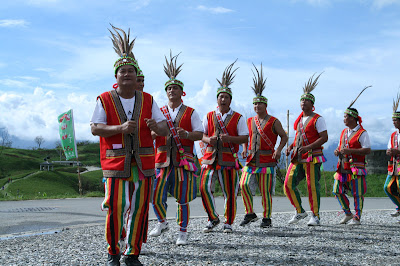
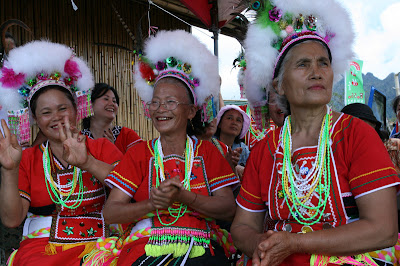
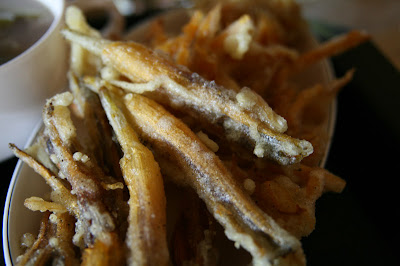
Performers at opening for hotspring festival Cute food

thought this was funny...a sign saying no spy cameras are installed at this hotel - with a spy camera next to it. Note the unfortunate name of the hotel!

Wednesday, October 10, 2007

Happy Birthday

Taiwan has been marking its National Day. And for the first time in 16 years, the official ceremony featured a military parade.


Fighter jets - American F16s, French Mirages, and Taiwan's IDFs flew overhead - while military vehicles drove past the presidential offie, carrying missile systems - including some domestically developed advanced missiles.


Some Taiwanese special combat units were also part of the event.


Of course the show of strength is laden with political symbolism. A message to China that Taiwan can defend itself against any military attack. And a message to the public to show that the island is capable of building its own defences.


Protestors - while few- were kept well away from the plaza. Barbed wire, riot police and plenty of road blocks.

Tuesday, September 18, 2007

Taiwan's dark village

View from Liushidan mountain - down in the valley below, is nestled the Dark Village

Its hard to imagine that in high-tech Taiwan – one of the most wired societies in the world – there can be any community without access to electricity. But there is: a settlement of aboriginals from the Amis tribe – one of the island’s 13 officially recognized tribes - living in Hualien county on Taiwan’s east coast. Its not connected to the electricity grid and has no access to power. Its known locally as as The Dark Village.

Amis villagers celebrate at a day lily festival.

Legal disputes over the land are the main reason the site never got connected to the mains grid. Decades ago, the land was seized by the government and developed for forestry. But today, the local people – members of the Amis aboriginal tribe; one of Taiwan’s 13 officially recognized tribes – are trying to reassert their ancestral land claims.

Amis women

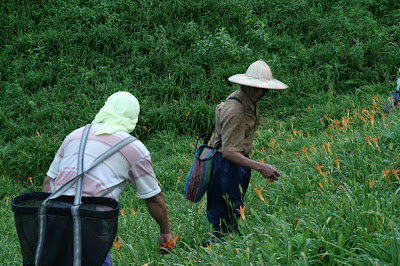
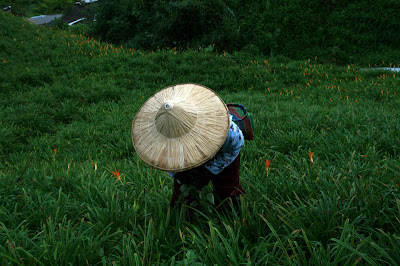
When I first met them, the tribe were celebrating at a newly-opened sales centre at a festival promoting their locally harvested crop - the daylily, an edible flower, which traditionally used in Chinese cooking, especially soups.


Early picked day lilies


day lily meal

Day lily fried chips


Day lily icecream

For the past three years, the non-governmental organization, World Vision Taiwan, has been working with the community, giving them technical and other training, helping them turn to organic farming methods. It means they can sell their crop at prices five times higher than before.

One of the community leaders, Sawmah tells me the project is giving people a new sense of pride – and employment opportunities for the tribe’s younger generation who would normally leave for the cities in search of work.

"Organic farming can earn us more money; and it’s a healthier product for customers to eat", he says. "My children picked day lilies when they were young..but for them it was difficult work. When they finished school, they chose to work in the city.
"But I told them they can come back any time; now we have this sales centre, they can work there, they don’t have to do farming. We are trying to achieve more here..and let young people see that if if you are a farmer, you can still have a good life. "


Will they still live in the village when they are older?

But life is still tough.

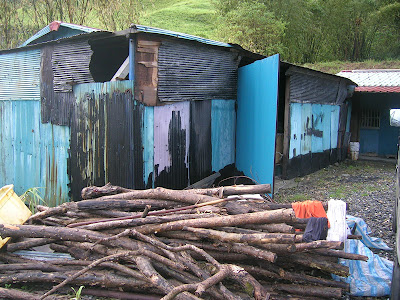
houses at the Dark Village - pic courtesy of World Vision Taiwan

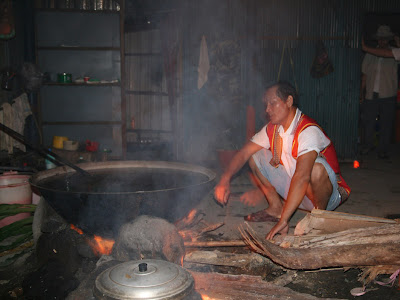
The tribe spend about half a year living in the Dark Village – during the main planting and harvesting season – housed in basic iron corrugated buildings. No electricity means they need to build wood fires to cook; At night, oil lanterns provide a little light. They’ve lived like this for years.

Cooking at night by fire in the village

"Having no electricity..its like being blind" , says 63 year old Kiko. She tells me its hard to keep food fresh- especially meat. I ask her what's the first thing she would buy if they had electricity in the village. " A refrigerator..a washing machine..a tv..a cell phone. lots of things", she says, barely pausing for breath.


These day lilies have bloomed..and cannot be eaten

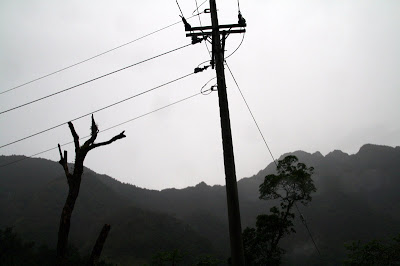
Those items could soon be within their grasp. The appearance a few months ago of electricity poles near their village in the valley – which were installed to pump stream water to a nearby mountain resort – is making many tribal elders, like Potal, keen to see their own settlement connected to the power grid.

Electricity poles appeared near the settlement a few months ago.

"I really really want power in the village", he tells me "because I've been living there forever. I want to enjoy some modern life..put something in the refrigerator; I don't want to heat up wood to burn things, to cook. I've been waiting for it all my life.", he says.


You might think the whole tribe would welcome the arrival of electricity - but that's not the case.

And, surprisingly, opposition is coming from the tribe's younger members. 28 year old Masawo says there’s a special community spirit – as they sit around fires at night singing songs and chatting – which he fears might disappear forever.

"We don’t have electricity, so people get together after work; chat, and talk about important things. In the past, we would tell stories and sing too. If we had electricity, we’d all just sit around watching TV and wouldn’t talk about things", he says.


Okoc, a mother of four, agrees. "We don’t want regular electriricty. I like things the way they are.
"Here we use oil lanterns, like in the old times. It seems better like that. If you had power, you wouldn’t be able to see all the stars; and all the natural living things, like frogs and other animals, would run away. "

The debate is creating such damaging divisions within the tribe that younger members say they will respect the wishes of the elders. But one compromise solution could be solar power - which would be more in keeping with the tribe’s goals of developing future projects like ecotourism and trekking.
But whatever’s decided in the future, with the advent of power, one thing’s for sure: the Dark Village will have to change its name for good.

Saturday, September 1, 2007

Happy journalists day

Not surprised by the general results of this poll, reported by CNA (Taiwan's Central News Agency). ..though nearly half wanting to quit their jobs is pretty depressing.

Time to have some media reform!


Reporters have mixed sentiments toward their job: survey

Taipei, Sept. 1 (CNA) Taiwan's reporters have mixed sentimentstoward their job, according to a 1111 Job Bank online survey released Saturday. The survey was conducted Aug. 23-30 among media reporters onwhether or not they are happy in their work, to coincide with the jobbank's celebration of Sept. 1 Reporters' Day.

The poll results show that 22.76 percent of the respondents wereunhappy with their jobs, while 31.41 percent said they enjoy work.Another 45.83 percent of the surveyed reporters were ambivalent.

Analyzing the results, the job bank found that reporters who saidthey were cheerful were mostly those who work for magazines,accounting for 44.45 percent of surveyed happy reporters.

Those who said they were unhappy and stressed were mostlytelevision reporters, accounting for 40.62 percent of all the unhappyreporters surveyed, according to the poll. Asked what kind of events they dislike covering, 60.58 percent ofthe respondents answered "controversial political events, " followedby "social events" with 58.33 percent. Lifestyle and travel are the two subjects that reporters lookforward most to covering, attracting 58.01 percent and 51.6 percentof the polled reporters, respectively.

Asked whether or not they wanted to change careers, 49.04 percentsaid they wanted out of journalism, while 50.96 percent said theywanted to remain in the business. According to 1111 Job Bank statistics, jobseekers who wanted towork as reporters had only 0.67 job opportunities on average in 2006,a ratio that dropped to 0.55 this year. In the August survey, the respondents anticipated that they willwork as reporters or related jobs for an average of 13.85 years. A total of 312 valid questionnaires were collected for the onlinesurvey.

Thursday, August 9, 2007

looking for recognition


Representatives from one indigenous group in Taiwan held a small protest, near the Presidential Office in the capital, Taipei, calling on the government to grant them official recognition and status.


The event – held by members of the Pingpu lowland indigenous people’s – was held to coincide with the International Day of the World’s Indigenous people. The protestors handed in a petition with their calls to the Presidential office
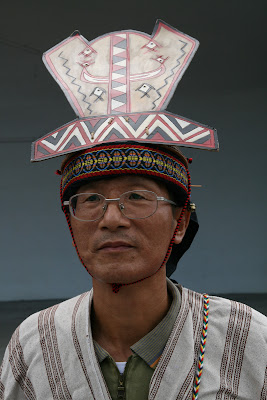
The Pingpu people – numbering around 200,000 - live in Taiwan’s western lowland plains , unlike most aboriginal groups who come from the island’s mountainous areas and east coast. Their geographical location brought them into the closest contact with the first wave of ethnic Han Chinese settlers to Taiwan four hundred years ago, hastening their assimilation into the main population.

As a result, many of their customs and languages began to die out. Today, pingpu dialects are only spoken in three out of ten tribes – and mainly by the elderly. Activists say their traditional cultures and languages are in danger of dying out altogether – unless they get government help.

Over the years, the authorities in Taiwan have granted official recognition to 13 aboriginal tribes –who make up about 2 per cent of the population – which gives them access to greater government funding and support to promote their indigenous culture and languages.

The Pingpu, though, have not been successful in their efforts for recognition - having failed to meet certain thresholds on language useage, cultural observance or possession of territory. They argue the thresholds have been set too high. And they’ve levelled accusations of discrimination and exclusion.

Whether they’ll be able to succeed in future efforts to lobby for government support remains to be seen; but time is running out. And some scholars have warned that, without official help, the unique culture of the pingpu people could disappear altogether within the next decade.

Wednesday, August 8, 2007

Rainbows

We've had terrible rains over the past few days thanks to a tropical storm. But today was quite lovely..breaking in was the sun ..and a rainbow.


Wednesday, August 1, 2007

Austronesian links

Taiwan, its 6 Pacific diplomatic allies, and the Philippines, announced they were establishing an Austronesian Forum - aimed at promoting closer ties between Austronesian members.

What's "Austronesian" ? you may ask. The Austronesian language is the world's biggest linguistic group, spoken by more than 200 million people.

Many scientists believe Taiwan was the birthplace of the Austronesian language family. Another, more controversial theory suggests that Taiwan could have been the original homeland of the Austronesian people, who then migrated to a wide area across the Pacific and beyond.
A beautiful traditional boat build by Orchid Islanders who rowed for the first time from their island to Taiwan.


The new Austronesian Forum aims to promote exchanges, academic, economic and cultural, between Austronesian communities. The body will be formally established next year. A draft charter pledges founder members to work to promote the goals of democracy, good governance, human rights and sustainable development .


This Hualien chieftan gave a traditional blessing at a ceremony to launch the first step in setting up the Austronesian Forum.

In recent years, the Taiwanese government has worked hard to promote its links with other Austronesian countries - seeing it as a way of trying to break out of its diplomatic isolation and stress its distinctiveness from China.

The island is recognised by just 24 governments around the world - six of them in the Pacific . Taiwan's own Austronesian people are members of the island's 13 officially recognized aboriginal groups who make up about 2% of the population.

President Chen Shui-Bian pointedly reminded his audience that Taiwan's indigenous peoples - like other Austronesian groups - had their own ancient cultures and languages which were totally different and unrelated to the culture of the Han Chinese - the main ethnic group in China and Taiwan.

But, like many aboriginals around the world, Taiwan's indigenous peoples have also been marginalized and faced discrimination. In recent years, though, they have gained more political power and recognition. Establishing closer links with other Austronesian countries could give Taiwan's own aboriginal communities a greater sense of pride and leadership - and wider respect .